
Why You Can’t Skip a Power Bank
Long trips have one common enemy: battery anxiety. We’ve all been there—your show cuts out mid-flight at 30,000 feet, your GPS dies during a road trip, or you’re on a crowded train and the only outlet is already taken by three other people. When your tech dies, you’re stuck.
You might not think about your power bank every day, but when you need it, it’s a lifesaver. For frequent travelers, a reliable power bank is just as important as a passport or credit card.
The problem? There are too many options. People often overpay, get the wrong model, or buy something they aren’t even allowed to take on a plane. This guide keeps it simple: forget the tech jargon and find the best fit for how *you* travel.
Three Ways to Travel, Three Ways to Power Up
1. Flying
This is the pickiest scenario. Airlines have strict rules for lithium batteries:
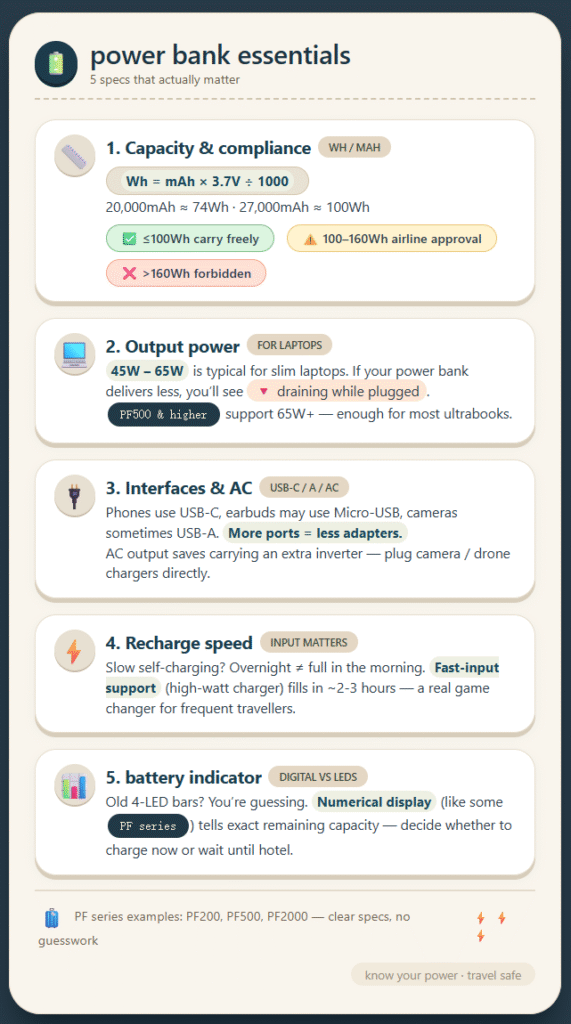
Under 100Wh: Good to go.
100Wh to 160Wh: You need airline approval.
Over 160Wh: Totally banned.
Pro tip: You must carry batteries in your hand luggage; they are strictly forbidden in checked bags. Since airport outlets are always crowded, having your own power is a game-changer.
2. Road Trips & Camping
Driving is a different ball game. Since there are no weight or airline limits, you can go big. If you’re off the grid for days, you’ll need a “portable power station” rather than just a small pocket charger. You’ll want something rugged that can handle phones, laptops, cameras, drones, or even small appliances like electric blankets.
3. Trains & High-Speed Rail
Trains are the middle ground. Outlets exist but are often limited or far from your seat. Since you’ll likely be using your devices for a long time in a cramped space, you want something with decent capacity that isn’t too bulky.
Which Model Fits Your Trip?
For the Frequent Flyer: You need a balance of power and portability.
The Go-To: PF500 stays under the 100Wh limit, so security is a breeze. It can charge a laptop once and still have juice for your phone.
The Light Version:PF300 are great for short flights if you only have a phone or tablet.
For the Road Tripper: Go for capacity and AC outlets.
The Powerhouse: PF2000 are best. Because they have AC outlets (like a wall plug), you can plug in camera or drone chargers directly.
Real-world use:One traveler used a PF2000 to run an electric blanket and charge two drones and three phones overnight while car-camping.
For Short Day Trips: Focus on “just in case” power.
The PF200 or PF300 are tiny enough to fit in a pocket. They aren’t meant to charge everything five times; they’re there to save you when your phone hits 5%.
5 Specs That Actually Matter
1. Capacity (Wh vs. mAh):Airlines look at Watt-hours (Wh). A 27,000mAh battery is roughly 100Wh—the “magic number” for flying.
2. Output Power: To charge a laptop, you usually need **45W to 65W**. If the power bank is too weak, your laptop battery might still drop while plugged in.
3. Ports: More ports mean fewer adapters. AC outlets are a huge plus for cameras or drones.
4.Recharge Speed:Check how fast the power bank itself charges. Models with “fast-input” can be filled up in 2–3 hours rather than all night.
5.Display: Forget the “four blinking lights.” Digital displays (like on the PF series) tell you exactly how much percentage is left.
Maintenance & Safety Tips
At the Airport:Take your power bank out of your bag for security—it makes the process much faster.
Weather Matters:Avoid leaving it in a hot car (it kills the battery). If it’s freezing outside, the battery might seem lower than usual, but it will return to normal once it warms up.
Long-Term Storage:If you aren’t using it for months, keep it at about **50% charge**. Don’t leave it totally empty or 100% full.
Time to Replace:If the case is bulging/swelling,stop using it immediately! Also, consider an upgrade if it barely holds a charge anymore or the ports feel loose.
Summary: Power Should Fit Your Trip
Don’t be the person who has to throw away a brand-new battery at airport security because it’s too big. Figure out how you’re traveling first, then pick the gear that fits. Let your power bank adapt to your trip, not the other way around.**
Would you like me to help you compare the specific dimensions and weights of the PF series models mentioned?

